Showing posts with label classic. Show all posts

Saturday, July 31, 2010

In-Box Review: Fantastic Plastic's Retooled “Beta-1”


Resin is an almost ubiquitous medium these days, used by professionals and enthusiasts alike, and often the line between them blurs away to nothing as skills grow and shoestring operations are replaced by full-on limited-production model firms. They're not just 'garage kits' now, they have in fact become a force to be reckoned with.

Fantastic Plastic is one of the success stories of the modern limited-run marketplace, specialising in science fiction, 'realspace' and 'paper' aeroplanes, with high quality kits patterned by master craftsmen and featuring the highest quality resin moulding and casting technology. These kits aren't cheap but they certainly deliver unusual subject matter.

It's not only Moebius and Polar Lights that resurrect classic subjects and recreate lost lines. Fantastic Plastic has had dozens of subjects through its catalogue in the last few years, and they recently released an eagerly awaited kit that brings to life an old 'what if' subject, a mid-Cold War design by the old Hawk company based on theoretical studies by Convair for a nuclear-propulsion bomber, presumably to replace the B-52 sometime around the end of the 1960s. Little could military planners have dreamed in those days that the B-52 would still be in service well into the 21st century.

Nuclear propulsion was a 1950s technological darling, something which worked on paper and was kicked around by 'backroom boys' but never saw the prototyping shop to the best of aviation historians' knowledge. The idea was that nuclear energy created heat which was passed to ingested air to create a ramjet effect without consuming liquid fuel, thus allowing an aircraft to remain in flight for long periods, indeed for as long as crew fatigue parameters would allow, and a whole slew of designs came along from major aircraft firms in the late 1950s.

Kit company Hawk cashed in on the public fascination with this extremely sci-fi concept and designed their “XAB-1,” the B-1 of an earlier era, as the flagship guardian of the West, intended to cruise for long periods on nuclear deterrent patrol, ready to head for targets in Russia if the world ever tipped into DEFCON-1... It's interesting to look back on how this nightmare scenario generated business for lots of people, and the kit industry's perpetual association with militaria is a prime example.


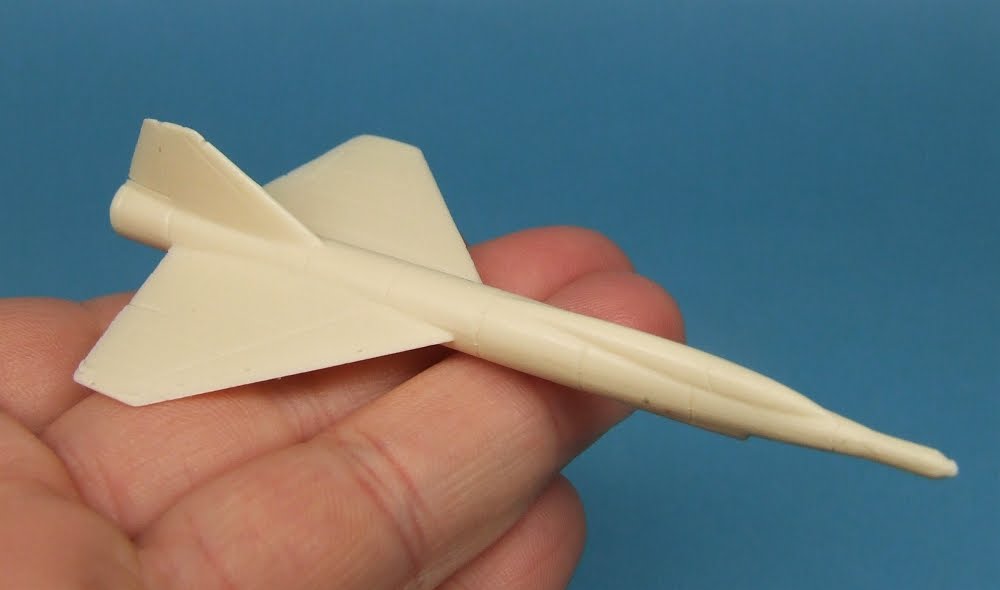
Hawk's original kit was injection moulded at 1:188th scale, and has become a collector's item. Rare unbuilt examples change hands at fabulous prices, a 1964 example is going at auction as I write this, they have become investment properties that one could never afford to build. Fantastic Plastic comes to the rescue with a fully retooled kit in pressure-cast resin, mastered by Scott Lowther and cast by Masterpiece Models, enlarged to 1:144th scale and featuring finely recessed panel lines in the modern style. The kits has a pencil-slim fuselage 17” long, landing gear which may be built deployed or retracted, waterslide decals by Jbot, and features photographic instructions. There is no cockpit detail, no detail in the wheelwells, and a few inconsistencies and flash in the resin to be cleaned up, but these are minor considerations. The original featured red plastic exhaust flames, a juvenile gimmick which has been dropped in this entirely serious 'take' on the subject, while the original's two 'parasite fighters' are also included as superb single-piece resin castings.

The kit comes packaged in a sturdy white card box, whose lid is decorated with a printed colour label featuring digital artwork combing the model with a realistic sky and CGI exhaust efflux, something of a Fantastic Plastic trademark. Inside, the largest castings, such as the one-piece wing and the right and left halves of the fore and aft fuselage sections, are loose in the box, the rest of the 45 parts being collected in a ziplock bag. Many parts are supplied with their pour-stubs already cleaned up.

The hollow-cast parts have alignment pegs and holes, allowing them to be snapped together exactly the same way as injection moulded parts, but curiously some of the pegs and holes don't match up, such as instances of opposing pegs. One needs to do some trimming of pegs and drilling of holes as part of the clean-up phase, but the good news is that the resin, while completely rigid, is soft to cut and works very readily. Go gently and adjustments should take almost no time at all.


There is no clear part for the cockpit canopy, and in so small a scale the model gets away with this. I have long harboured an interest in scratchbuilding this beast in 1:72nd scale, she would be a monster 34” long and 22” in span, and would definitely have a cockpit interior and clear parts. The interesting thing is that the layout of the super-streamlined nose virtually forbids a side-by-side pilot crew configuration, which is widely known (now) to be the only workable one for long duration flight.


I will be building this kit shortly as a review for a major magazine, so look for retrospective comments on Fantastic Plastic's Beta-1 in about a month's time. For now, the kit can be purchased for US$105 from Fantastic Plastic's online store, check it out at:

http://www.fantastic-plastic.com/ConvairXAB-1CatalogPage.htm

Wednesday, September 30, 2009

The Immortal Classics: Polar Lights’ Seaview


There are always kits we remember from childhood, or kits we never knew when they were available but heard about long after. Aurora’s Seaview, from Voyage to the Bottom of the Sea, is one of those for me.

I only heard about it 15 years after the molds were lost in the neo-legendary Amtrak wreck that destroyed so many of the old classics, when it was featured as the very first instalment in the “Classic Kits” series in FineScale Modeler. I checked around to see if anyone had one and located one at Hobby Bounties in Singapore: if I remember correctly, the price was equivalent to $1000 Australian dollars in the early 1990s, the highest price I personally have ever seen on a classic kit. Needless to say, I didn’t buy it! My memory may be playing tricks, but I remember it being a three-figure sum of some sort.

Imagine my excitement when I heard several years later that Aurora-retool firm Polar Lights, in the course of recreating many of the lost classics, were resurrecting the Seaview!

I determined to have one at once, but it never happened. The kit was ‘new stock’ and thus ‘around’ and there was no urgency to buying it if dollars were tight for other reasons. In the odd way things happen, the retool has itself become a traded commodity and I recently picked one up on eBay for a good price. The precise recreation of the original is amazing, the actual box art and design from 1967, the identical plans with a few extras to denote the 2002 issue. 


Here’s a piece of history brought back to life and itself now a thoroughgoing legend in its genre, something few would have ever expected to happen, the remanufacture of a classic. Of course, there are many who would point out that in regenerating a classic product one regenerates all the shortcomings of that product. It’s the 1961 movie version of the sub, not the configuration of the series (which itself varied in detail between the 110 episodes), the detail level is sparse, and at around 13” long she’s not very big. A resin update set was made for it to build the series window configuration and the Flying Sub hangar: the AM guys will always ride to the rescue! There have of course been plenty of much larger versions produced in resin in the last decade and a half, and we now have Moebius’s ultimate kit, injection molded and nearly 40” long, for which a plethora of after market add-ons have been produced – even including complete radio control and power system to build a sea-going Seaview that will dive in your swimming pool!

Next to that, the old classic pales to insignificance, but you know what? Nobody will build the operational boat, or even the 40-inch display masterpiece, in a weekend, and have it on shelf or desk, beautifully airbrushed and weathered, by Sunday night. And there’s the fun part: there are many small scale submarine kits and this one falls right in to that range as a science fiction classic that has sailed on in the hearts of it’s fans for all 45 years since the series premiered (on September 14, 1964, at 7:30 PM, EDT, on the ABC Network, for those who like their facts - with thanks to those who keep track of such things!) So there’s room for all the versions and all the kits.  

I have only one criticism: Polar Lights molded it in black plastic. Maybe they were being true to the original, but black is very difficult to work with, and I find it rather depressing. It’s a good job she’ll be a quick build, I can get her into some nice grey primer, and relax into painting and weathering thereafter.

I finally have that Seaview I always wanted! The companion piece to the Aurora 1:64th scale Flying Sub that was reissued by Monogram in the late 1990s and which has been part of my stash ever since. And … I guess it’ll tide me over until I can assemble the big bucks to tackle the Moebius masterpiece. So keep watch and I’ll post a review when I build her.

Saturday, August 22, 2009

Where would we be without superglue?


When I was a kid the standard household tube glue in England was called Bostik, and if I remember correctly my earliest Airfix kits (bagged, Series 1, chosen from the front window of the newsagent at the end of the street -- ah, what a memory!) were assembled with this stuff. It was stinky, it was stringy, and it blobbed, but it was all there was! When I came to Australia with my family in 1971 the model glue of choice here was Britfix, I think there was a ‘77’ on that name but it’s too long ago to be sure. It was stinky, it was stringy, and it blobbed, in fact in every meaningful way it was Bostik in a different tube, so while it left something to be desired, it was familiar.

These were the days when parts had to be left for ages to dry, clamped and rubber-banded, even overnight, and one would cautiously remove the bands to see if things had actually set or if the model would fall apart when moved. This, despite Britfix actually being rated a ‘welding’ glue, i.e., solvent-based. Landing gear was fragile beyond words and the glues available took a mature touch to get them to cooperate--little wonder all my fighter planes as a kid were built gear-up.

I was 12 when I first encountered Testors Liquid Cement, and I thought Christmas had come. A strong cement (note, the word ‘glue’ had abruptly become old-fashioned), which applied neatly with that handy brush built into the bottle cap (praise be to the engineer who thought of something truly practical!), and which dried essentially invisible. And it had grip! The first model I tackled with it was Monogram’s 1:72 B-52, ambitious for an early teen if I say so myself. Things remained static for many years, then. ‘Superglue’ was a mysterious and dangerous substance around which the words ‘skin graft’ floated. I remember being with my dad when he bought a tube one day (mid-70s, I guess) and the retailer cautioning him about it sticking fingers together, that it was indestructible and a skin graft would be required if this dreaded accident occurred.

The truth was a closely guarded secret in marketing terms, I only heard the facts recently. I thought it was miraculous back in the 90s when I bought some PicApart, a simple water-based solvent that dissolves cyanoacrylate, but of course the chemists who invented the stuff (in the 1960s, I heard, as a battlefield surgical tool for sticking wounds together when there was no time for stitches!) had always known its strengths and weaknesses. Acetone is the principle solvent, which is why it’s a fair bet so many macho hobby guys who build powerful, filthy tanks, rusted to perfection and draped with the battle flags of fascists and communists, have a bottle of nail polish remover hidden somewhere in their workshops. Probably behind the bottle of brake fluid they use to strip old paint, but that’s another post! 

At first I resisted using superglue, it seemed too strong, liable to melt plastic or lock up parts in the wrong order. Meah... It you want severe, try Revell Contacta Professional, in the precision applicator, I’ve never seen plastic disintegrate like it before or since. (Except that fine component in a Hobbycraft kit that dissolved before my eyes under the assault of old fashioned Testors Liquid Cement, but that’s another post too...) I think I began to use superglue after reading Paul Boyer’s Basic Techniques/Advanced Results series of articles in FSM in the early 90s, and realised that a precise parts-fit coupled with superglue in the seam created a rock-solid joint which could be dressed with a knife blade and sand paper and -- wallah! -- the seam was invisible. This was the holy grail of finishing skills at the time, how to defeat the appearance of the model being a model.

I developed that skill in the decade following until it was easy as breathing. When my brother in law came down from the States many years ago he looked at my models and the first thing he said was ‘I can’t see how it went together... How did you do that?’ (I rarely preen, but that was an occasion.) The model I think was Horizon’s 1:30th scale vinyl T. rex, a model which took ingenuity and a swag of different techniques as I had never built a vinyl before … and never seen gaps like those either. Superglue to the rescue (and shims, putty and plasticine). Another kudo...

What would we do without superglue? Joints would all need putty again, unless the fit was precise enough to be closed up firm with liquid cement alone (old kits and limited-run subjects would be a lot less popular). Rubber bands and clamps would be in demand. “Allow to dry overnight” would reappear in instructions, and kitchen tables would be commandeered with stacks of books and paint bottles carefully balancing models in the dark hours while landing gear dried (shhh, tiptoe past in case it moves!), then there would be a giddy experimental moment the next day when the set was tried out and the hobbyist held his or her breath to see if that carefully finished fighter’s landing gear would collapse under it. Nostalgia, with a certain jaundiced outlook -- and maybe superglue isn’t solely responsible for remedying these ills, I’m sure a competent builder could put a quality modern kit together with the tube glue still rated safe for junior modellers, and come up with a perfectly good result. But a touch of the cya sure makes things easier!

Wednesday, July 1, 2009

The Very First Kit


Can you remember your first kit? Can you remember where and when it came to you, and what it was that drew you to the hobby in the first place?

I was five years old the first time I saw plastic kits and understood them for what they were. Airfix Series 1 bagged kits, in a window display at the newsagent at the end of my street. I remember my dad taking me to the shop on a Sunday morning and buying me an Airfix Tiger Moth. He built it for me as I watched, rapt, and by the end of the day there was a bright yellow (it was molded in trainer yellow in those days) biplane for me. I was fascinated, and wanted more!

The following week was the same pattern, and the Airfix Bristol Fighter joined the Tiger Moth. And in the weeks after, each Sunday morning brought a new shape in plastic: the Westland Whirlwind was one, the Gloster Gladiator another, and the F-5A was the first jet in the collection, as well as the first kit where I was sufficiently inspired to try my own hand and help out on the building. I think the Me 262 was one of them also.

A child’s nimble brain is way ahead of his or her dexterity in relating the shapes and how they go together, and there is always a lot of frustration in getting from A to B—A being the fresh kit and an idea in mind of what the product should look like, and B being the actual result. But I do remember my family never stinting their praise for my efforts, no matter how far I had to go to perfect the skills involved. As a child I was more interested in quantity than quality, and production-lined models through at an amazing speed, without giving a thought to accuracy or moving beyond the limitations of the kit, but these things developed automatically as the years went by.

I still have a fondness for that so-simple Airfix Tiger Moth, and Roy Cross’s classic box art. I have it in my stash (that's the box top of the current issue above), and one day I’ll do the best job on it I possibly can, including rigging and maybe score out the control surfaces and reposition them. There’s only so much you can do with 25 parts, but as with the generation of RAF pilots who began their flying career in De Havilland’s classic trainer, this aircraft, and this particular kit, will always mean the beginning of the road to me.

Friday, May 29, 2009

New Life for an Old Classic


 Plastic modelling has been around now for over half a century, and one thing that well-cared-for molds have is shelf-life. One thinks of old molds ‘showing their age,’ but that is perhaps more to do with the sheer number of pulls taken from them. If they’re properly stored, in a moisture-free environment, tooled steel should last, and it seems it does.

Lately Revell have been reissueing early kits under the ‘Classics’ label, in limited editions of 5000 pressings. This is probably the same group of molds returned to service about 15 or 20 years ago as the ‘History Makers’ series. Revell’s 1:40th scale armour, originals of which have fetched high prices on the second hand market, seem to be putting in an appearance, and I was recently lucky enough to pick up their Nike Hercules missile for a good price from an eBay trader. 


 I find myself very impressed: the packaging reproduces the classic artwork, the instructions are Revell-standard, the decals are beautifully printed, and the molds seem to have lost nothing for their fifty years in storage. The model is blown in dark green styrene, and quite a large finished article is packed in a smallish box. 


I first saw this model in what looks like a company promotional photo (note the classic packaging, it’s the same painting on a differently shaped box) in a book dated 1961 (below) and have wanted one ever since. I’m really glad to have found this one. It will build as a very nice companion piece to Trumpeter’s 1:35th scale SA-2 Dvina missile, the direct contemporary of the Hercules in the same role. The scales are close enough to display them together without one overshadowing the other.


Like the Dvina, the Hercules was built in huge numbers and served a very long time. The new instruction sheet, dated 2009, states that between service introduction in 1958 (when it replaced the Ajax, becoming America’s second SAM system) and its retirement from domestic service in 1978, 25, 550 units were built. While that may not rival SA-2 production, it is a gigantic investment in a weapon system which, whether conventionally or nuclear-armed, was never fired in anger. Its value as a deterrent, however, must have been considerable, as with a climb envelope of 150, 000 feet and a speed at propulsion burn-out typically around Mach 3.65, oncoming bomber formations would be sitting ducks.

I see lots of rivets, as was standard detailing at the time, and I’ll have to research the real missile to see what was actually visible. It strikes me I might sand away the rivets before assembly, possibly redrilling some or all if I can find a fine enough bit, and if photographs show them contrasting with the gloss white finish. I’ll be most interested to see how this old classic builds, and one day perhaps come across other examples to depict at different points in the weapon’s service lifetime, or even create a battery diorama. I hope the re-release sees an enthusiastic response, and that Revell will be encouraged to release more of their early subjects in rejuvenated form. (I would love to build their 1:40th scale Scissors Bridge, the bridge-layer based on the M48 Patton-series MBT chassis.)

Here are some great research links for the Nike Hercules missile: http://en.wikipedia.org/wiki/Nike_Hercules

These are some highlights. Just Google “Nike-Hercules missile,” there’s lots more out there!