Showing posts with label Tiger II. Show all posts

Friday, August 28, 2009

Big Models for the Big Boys


 No, I don’t mean radio control. I don’t mean those two-stroke motors that seem to be revving at ear-splitting volume in hobby shops every time you go in to find that bottle of paint you need, and I don’t mean the endless shock absorbers, steering gear and offroad tyres that seem to take forever for shop staff to sort out for the people permanently in line ahead, hogging the counter... I’ve nothing against RC, really -- but that’s another post!

No, I mean BIG MODELS. That Dragon or Trumpeter 1:35 Leopold railway gun. Italeri’s new 1:35th scale German Schenllboot. Andrea’s gigantic 1:32nd scale U-boat. Revell’s old B-1 bomber in 1:48th scale. Monogram’s classic 1:72nd scale B-36. Airfix’s 1:24th scale Harrier. Heller’s 1:100th scale sailing ships. And so on...  


 Is it the mystique of the very large that attracts us? Is it the possibility of acres of minute detail? Is it the childlike thought of having a bigger one than the next modeller? Or is it that some subjects just can’t be done justice to any smaller? The state of modern tooling suggests 1:48th scale is a good benchmark for realism, incorporating a fair detail resolution against the real thing and a general simplicity of construction, so demanding bigger is not necessarily the answer (though consider the detail found on Tamiya’s F-4s in 1:32nd scale... Bigger sometimes is just plain better).

There’s the status aspect. Bigger models are more expensive, and modellers at both an advanced skill level and approaching the rollover time of life are a major part of the target demograph that can actually afford them. (“Do we have to go on that cruise next winter, Martha? I had a hankering for Trumpeter’s 1:16th scale King Tiger...” After which the hobbyist probably slept on the couch.)  


 But what about really big: those limited-edition monsters that sometimes appear. Of course, I’m thinking about the 80cm K(E), the Dora, the biggest gun ever fired in anger. It first appeared at European toy fairs about four years ago, a 1:35th scale kit initially researched and designed by Heller IIRC, but after the demise of the company it was taken over (if I’m understanding correctly) by an independent firm, and molded in a limited edition of 1000 copies, in China. As a $1000 kit, that’s a million dollars turnover in one property, though it has been permanently discounted to US$700 for the last two years or so. At the present exchange rate, that’s nearly a grand in Australian money. It would take a seriously dedicated hobbyist to square away the funds for that (though to be fair, the cost is still significantly lower than Tamiya’s RC tanks and trucks. In England there is a hobby finance company that loans out funds against them as if you were buying basic transport to get to work.) That brings to mind Tamiya’s RC Tiger 1 and the costs involved, over $1500 Australian some years ago. I remember casting an eye on it longingly and my sister saying “you’ll look ridiculous driving to work in that on Monday.” The implication being you could buy a car for that price.  


 But does larger scale really mean more detail? It means a different feel, that’s for sure. Compare tanks in 1:72nd, 1:35th and 1:16th scales. Between the first two scales there is a wealth of difference, and it takes a surgeon’s hands to make a 72 -- they don’t call it Braille Scale for nothing -- really look the part. It can be done, there are brilliant mini-masterpieces out there, and better kits than ever before to work with. But 35 seems to be the charm, the perfect balance point at which the techniques that come naturally to hand find their best and simplest expression. Academy have those big 25th scale Panthers and Jagdpanthers, and Tamiya have just reissued their 1:25th scale Tiger and Chieftain, for the first time in something like thirty years (SF modellers will be rubbing their hands as the latter has been fetching US$60 on eBay and is needed for some studio replicas). The AM guys must have thrown prayers of thanks skyward when these kits were re-released, the accessory sets are already hitting the market… 1:16th scale is a new situation completely, in which the delicacy of touch one evolves for 35th generates effects that are almost invisible at a normal viewing distance: one must learn to weather with a broader brush, a heavier hand.

In the end, perhaps it is personal choice, as with every aspect of the hobby. The lifetime 1:72nd scale aircraft builder will fit a lot more of them into a display case than the ship modeller who builds at 1:96th, and the armour modeller who prefers Braille Scale will have far more space and funds than the 1:35th scale builder, but these are practical matters, and the aesthetic of the thing probably ultimately commands the decision. We like what we like, and that’s the end of it. There’s a certain undeniable fascination to palm-top Panzers, but part of me has a hard time taking them seriously.  


 Of course, it could be simpler... It could be that we start out affording small models and fill shelves with them, and they gradually get bigger as we get older, in proportion to the thickness of our glasses. By the time we retire our eyesight is so shot we have to build the big ones: we have no choice, we just can’t see the teensy ones anymore! Okay, extracting tongue from cheek... Normal service resumes next post!


I have the Harrier in my stash and would have photographed those huge parts but it's in a carton on the bottom and I didn't fancy excavating down to find it...

Tuesday, July 14, 2009

Why do so many companies have trouble with tracks?


Tracks... All armoured vehicles over a certain weight have them. They come in endless styles, narrow ones, broad ones, cleated tracks, padded tracks, live track, dead track... Amtracks with ‘swimming grousers,’ Shermans with ‘snow grousers,’ Panzers with Ostketten. The fascination with modelling tanks brought with it the challenge of companies producing realistic tracks, and most modellers would say they’ve never really achieved 100% accuracy no matter what approach they’ve taken.

There are traditional flexible vinyl tracks, single-piece, to be joined around the running gear, and they do a generally good job. In the early 1970s they tended to be poorly detailed and possibly undetailed on one side, though today molding technology and computerised machining of the molds means they can be highly detailed both sides. The ones above are from Tamiya’s 1:35th scale King Tiger, Ardennes. The drawback is that the relative stiffness of the vinyl means the tracks don’t develop a sag between the return rollers, or lie along the top of large diameter wheels, like real tracks do. 


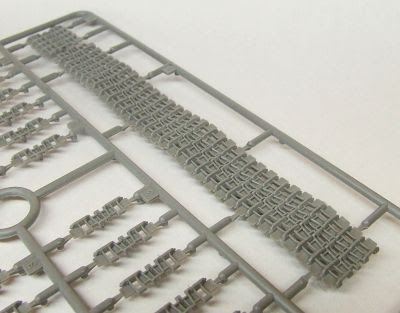
 Then there are individual-link or link-and-length tracks, which call for cleanup and assembly. For some modellers these are the best, though for others they are a nightmare whose tedious nature more than forgives the lack of sag in the vinyls. Above are the indie links made by Academy to compliment their issue of the early Tamiya Panzer IV-derived tanks (all the models on the box are of Tamiya origin). And below are ModelKasten’s set for the above-mentioned King Tiger. 


If sag is your thing, Trumpeter got ambitious a few years ago and produced superbly machined link-and-length tracks for their KV-1 series of kits in which the sag over the return rollers was molded right in, and even the most die-hard anti-L&L builder must feel tempted by these amazing pieces of injection work:  


Then come the workable tracks from AM companies, whitemetal, plastic or resin with wire pivots taking the place of the real track bolts, and which will hang, sag and roll like real (dead) track -- for a price.  


Dragon came up with Magic Tracks, a soft styrene type in which the links click-fit and will hold their shape until you can hit them with liquid cement, lending themselves to being shaped to any configuration of suspension. This is a neat idea and probably the most innovative. Vehicles with skirts tend to make that perfect hang and sag of the return length superfluous though: you can’t see it, so why sweat blood on it? And tight tracks don’t sag anyway. But tightness raises the question of why some companies don’t seem to be able to get it right in the most profound sense. 


I’m talking about early Trumpeter. I was really attracted to the Chinese Type 89 tank Destroyer, and was building along quite satisfactorily -- until I came to the tracks. They were half an inch too short (below) to link up around the running gear, and no amount of coaxing was going to change that: snapping off the portside idler wheel convinced me to give up. I tried heat treatment, stretching them by heating them with a hair drier, and hanging them with weights, but after half a dozen exhaustive treatments, using all the heat my hands could tolerate, one track had grown about one link’s worth, as the vinyl shrank again upon cooling. I was fed up and shelved the project. That late-mold Tamiya StuG III I reviewed last time was both a pleasure and a relief to build instead.


 Of course I didn’t give up entirely. The Type 89 shares the same chassis with the 122mm MBRL and the Type 83 SP artillery, I have them all, and all I would need is a single extra length of track to complete them. Cut out a few links and splice them in with superglue and thread as necessary, and suddenly the tracks will go round the running gear and meet as they should. I emailed Trumpeter, seeking to buy a spare length of track, got a reply asking me to forward photographs of the parts involved... Then nothing. Hey, I tried, but their aftermarket support at this point is as dodgy as their English, which is curious given their truly ambitious products and their dedicated assault on the affluent end of the Western marketplace. Their more modern products are of higher quality, I would certainly hope the tracks are the right length given the price they charge for their new armour.

And what about Dragon? That other Chinese company often considered to have eclipsed Tamiya as king of 1:35th scale? Early Dragon is beset by far too many microscopic parts which vanish into the carpet, and by the sort of over-thought engineering that has Dragon airplane models glide into waist bins beside the benches of grown modellers sobbing with frustration at their sheer unfriendliness and inaccuracy of fit. This is the antithesis of Tamiya’s philosophy, and while Tamiya’s earlier products may not be acceptably accurate or sufficiently detailed for today’s more mature taste, you can mostly rely on them to build well. “Buildability” was Mr. Tamiya’s watchword, and is sure to have contributed to the company’s historic success.


My only experience with early Dragon is in the reboxing of their classic Russian armour models when the molds were obtained by Zvezda. Their BTR-70 built fine, only a few grab handles needed to be replaced with brass because they broke before I could remove them from the sprue (because the parts were finer than their sprue attachments!) But their T-72 is another matter. It may be Zvezda’s plastic: the link and length tracks are brittle and the plastic really does not like to react with superglue (a bit like Chinese plastic in that respect). Thus trying to piece those tracks together promised to be an exercise in frustration. The Zvezda T-72B with Explosive Reactive Armour is easily the most detailed tank model I have ever built, and it sits unfinished in its box because there is no way I’ll mess around with that job, and the only AM T-72 tracks I can locate are far more expensive than the kit was. My prayer, thrown to the gods of styrene, is that AFV Club will finally produce high quality vinyl replacements in their expanding range of sell-alone tracks.

Which brings me back to my lament, why can’t companies with all the expertise and the million-dollar computer-assisted design and manufacture, get the tracks right? Properly detailed, that fit the sprockets exactly, articulate with each other, and take a realistic paintjob? If it has to be link-and-length, then the plastic had better respond well to glue, you certainly can’t stitch them together. And if they’re vinyl then is it too much to ask that they be the right length?

These criticisms don’t apply to modern Tamiya products, modern Dragon, or, as far as I know, current Trumpeter or Revell-Germany. But they can all be criticised for their sometimes exorbitant prices. I know, I know—I want it all ways, tracks that fit and an affordable price. I’m just out of touch with reality...